
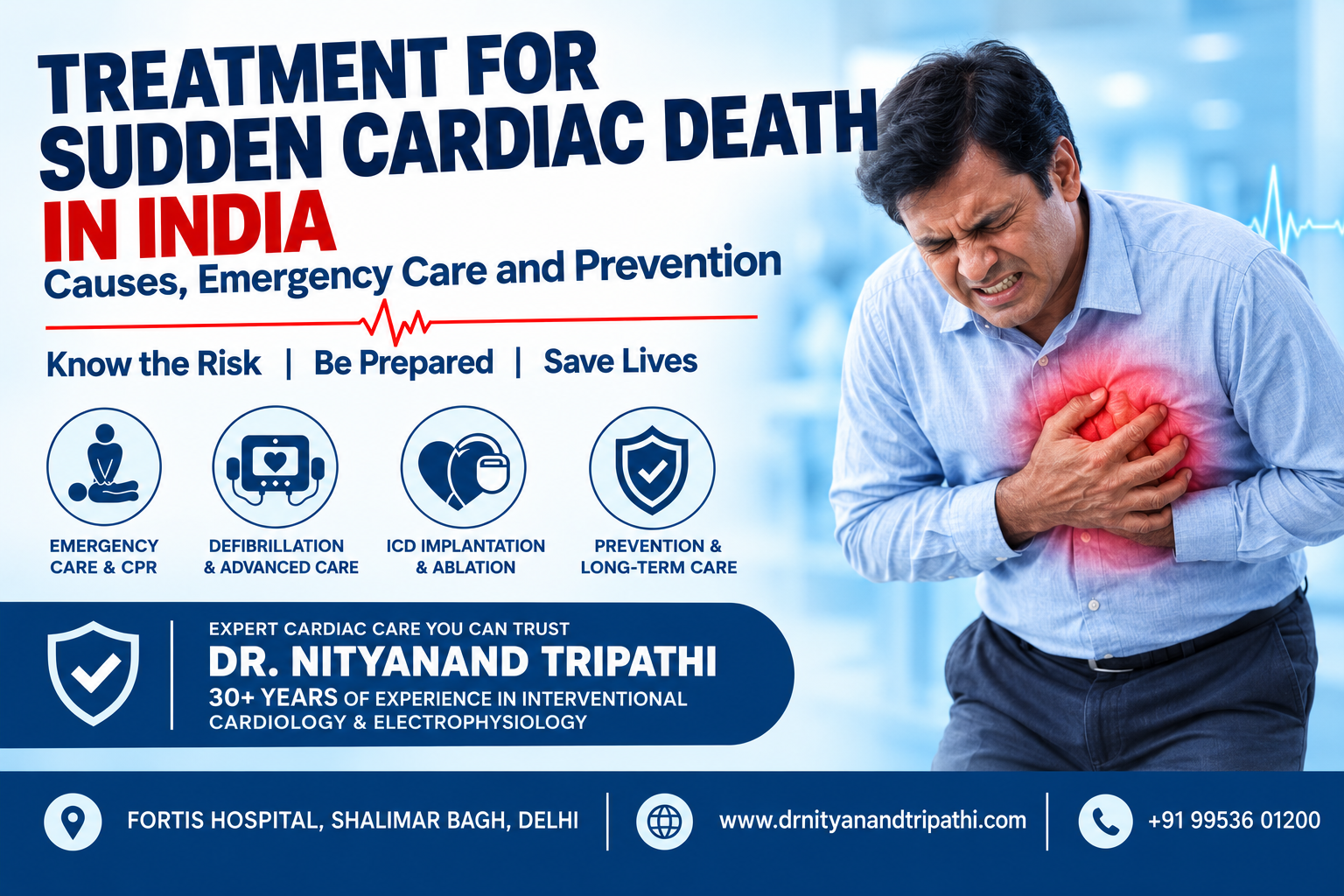
Sudden cardiac death (SCD) is one of the most serious cardiac emergencies and can occur without much warning. It happens when the heart suddenly stops functioning effectively, usually because of a dangerous electrical rhythm called an arrhythmia. Without immediate treatment, sudden cardiac arrest can quickly become fatal. However, rapid CPR, defibrillation, emergency medical care and appropriate long-term cardiac treatment can significantly improve outcomes.
For patients and families searching for treatment for sudden cardiac death in India, understanding the causes, emergency response and available preventive treatments is essential.
What Is Sudden Cardiac Death?
Sudden cardiac death refers to an unexpected death caused by the sudden loss of effective heart function. It is commonly associated with ventricular arrhythmias such as ventricular fibrillation (VF) or ventricular tachycardia (VT), although several other heart and non-heart conditions can contribute.
Sudden cardiac arrest is different from a heart attack. A heart attack occurs when blood flow to part of the heart muscle is blocked, whereas cardiac arrest occurs when the heart suddenly stops pumping blood effectively. However, a heart attack can trigger a life-threatening arrhythmia and lead to cardiac arrest.
Common Causes of Sudden Cardiac Death
Several cardiovascular conditions can increase the risk of sudden cardiac death. Some of the important causes include:
- Coronary artery disease
- Previous heart attack
- Cardiomyopathy or weakened heart muscle
- Heart failure
- Ventricular tachycardia or ventricular fibrillation
- Certain inherited heart rhythm disorders
- Hypertrophic cardiomyopathy
- Significant abnormalities of the heart’s electrical system
- Severe electrolyte abnormalities
- Certain structural heart diseases
People with a previous episode of cardiac arrest or sustained ventricular tachycardia may have a particularly high risk of another life-threatening rhythm and require specialist evaluation.
Emergency Treatment for Sudden Cardiac Arrest
Sudden cardiac arrest is a medical emergency where every second matters. If a person suddenly collapses, becomes unresponsive and is not breathing normally, emergency medical services should be activated immediately.
1. Cardiopulmonary Resuscitation (CPR)
High-quality CPR should be started as soon as possible. Chest compressions help maintain blood circulation to vital organs, particularly the brain and heart, until a defibrillator or advanced medical team becomes available.
Indian emergency-care training materials emphasize uninterrupted, high-quality chest compressions and early defibrillation as key components of cardiac arrest management.
2. Defibrillation
If the cardiac arrest is caused by a shockable rhythm such as ventricular fibrillation or pulseless ventricular tachycardia, an automated external defibrillator (AED) or manual defibrillator may deliver an electrical shock to restore an effective rhythm.
Early defibrillation is a critical part of cardiac arrest treatment, and CPR should be resumed promptly after the shock when indicated.
3. Advanced Cardiac Life Support
In a hospital or emergency setting, advanced cardiac life support may include airway and breathing management, intravenous medications, rhythm monitoring and repeated defibrillation when appropriate.
Depending on the underlying cause, emergency coronary angiography and revascularization may also be required, particularly when cardiac arrest is associated with an acute coronary event.
Treatment After Surviving Sudden Cardiac Arrest
Surviving cardiac arrest is only the beginning of treatment. A detailed evaluation is required to identify why the event occurred and determine the risk of recurrence.
Doctors may recommend investigations such as:
- Electrocardiogram (ECG)
- Echocardiography
- Holter or extended rhythm monitoring
- Coronary angiography
- Cardiac imaging
- Blood tests, including electrolyte assessment
- Electrophysiological study in selected patients
- Evaluation for inherited or structural heart conditions
The treatment plan depends on the cause of the cardiac arrest, heart function, rhythm abnormality, age, medical history and overall health.
ICD Implantation for Prevention of Sudden Cardiac Death
One of the important long-term treatments for selected high-risk patients is an Implantable Cardioverter Defibrillator (ICD), also called an AICD.
An ICD continuously monitors the heart rhythm. If it detects certain dangerous ventricular arrhythmias, it can deliver appropriate therapy, including a life-saving electrical shock.
Clinical guidelines recommend ICD therapy for appropriately selected patients who have survived sudden cardiac arrest caused by ventricular tachycardia or ventricular fibrillation when the event was not due to a reversible cause and meaningful survival is expected.
ICD therapy may also be considered for certain patients who have significant risk factors for sudden cardiac death even before an arrest occurs. The decision must always be individualized by a cardiologist or cardiac electrophysiologist.
Catheter Ablation and Treatment of Heart Rhythm Disorders
For some patients, dangerous ventricular arrhythmias may be treated with medications and/or catheter ablation.
During an electrophysiology procedure, specialists identify abnormal electrical circuits within the heart. Radiofrequency or other ablation techniques can be used to eliminate selected abnormal electrical pathways.
Catheter ablation may be particularly relevant for patients with recurrent ventricular tachycardia or other significant arrhythmias. The appropriate treatment depends on the underlying cardiac condition and detailed electrophysiological assessment.
Treating the Underlying Heart Disease
Preventing another episode of sudden cardiac death also means treating the condition responsible for the initial event.
For example, patients with coronary artery disease may require medication, coronary angioplasty or other revascularization. Patients with heart failure may require guideline-directed medical therapy and, in selected cases, cardiac devices. Patients with specific rhythm disorders may require anti-arrhythmic treatment, ablation or device therapy.
Therefore, treatment for sudden cardiac death in India should not be viewed as a single procedure. It is a comprehensive process involving emergency resuscitation, diagnosis, treatment of the underlying disease and long-term prevention.
Can Sudden Cardiac Death Be Prevented?
Not every episode of sudden cardiac death can be predicted or prevented. However, identifying cardiovascular risk factors early can help reduce risk.
Important preventive measures include:
- Regular cardiovascular check-ups when medically appropriate
- Controlling blood pressure and cholesterol
- Managing diabetes
- Avoiding smoking and tobacco
- Maintaining a healthy body weight
- Following a heart-healthy diet
- Staying physically active according to medical advice
- Taking prescribed cardiac medications regularly
- Investigating unexplained fainting or recurrent palpitations
- Seeking evaluation when there is a significant family history of sudden cardiac death
Awareness of CPR and access to defibrillation are also important public-health measures. A 2026 position statement from the Indian Society of Electrocardiology highlighted the need to improve CPR awareness, bystander response and public access to defibrillation in India.
When Should You Seek Emergency Medical Help?
Symptoms such as sudden collapse, loss of consciousness, absence of normal breathing, severe chest discomfort or severe breathlessness require immediate emergency attention.
Do not wait for a routine cardiology appointment if someone is experiencing symptoms suggestive of cardiac arrest or a major cardiac emergency. Activate emergency medical services and begin CPR when appropriate.
Consult an Experienced Cardiologist for Sudden Cardiac Death Risk
Patients who have experienced cardiac arrest, unexplained fainting, serious arrhythmias or other high-risk cardiac conditions should receive evaluation from an experienced cardiologist and, when appropriate, a cardiac electrophysiologist.
Dr. Nityanand Tripathi – Best Cardiologist in India
Dr. Nityanand Tripathi is the Principal Director & Head of Cardiology & Electrophysiology at Fortis Hospital, Shalimar Bagh, New Delhi. With 31 years of clinical experience in clinical cardiology, interventional cardiology and cardiac electrophysiology. His areas of expertise include advanced electrophysiology, radiofrequency ablation, pacemaker implantation, ICD/AICD implantation, CRT devices and complex coronary interventions.
For patients searching for the best cardiologist in India for advanced cardiac and electrophysiology care, Dr. Nityanand Tripathi provides individualized evaluation and treatment based on the patient’s condition, investigations and risk profile.